The Revolutionary Legacy of Bauhaus Furniture: How Three Iconic Chairs Changed Design Forever
In the tumultuous years following World War I, a revolutionary design movement emerged from Germany that would forever change how we think about furniture, architecture, and everyday objects. The Bauhaus school, founded in 1919 by architect Walter Gropius, championed the radical idea that beautiful design should be accessible to everyone—not just the wealthy elite. This philosophy gave birth to some of the most iconic chairs in design history, three of which continue to captivate and inspire us nearly a century later.
The Birth of a Design Revolution
Picture Weimar, Germany in 1919. The country was rebuilding from the ashes of war, and a new generation of artists and designers was questioning everything—including what furniture should look like and who should be able to afford it. The Bauhaus movement emerged with a bold manifesto: form follows function, and good design should serve the masses.
This wasn’t just an aesthetic choice; it was a social mission. The Bauhaus pioneers believed that well-designed objects could improve people’s lives and create a more equitable society. They stripped away ornate Victorian decorations and embraced clean lines, industrial materials, and mass production techniques. The result? Furniture that was simultaneously radical and timeless.
The Wassily Chair: When Bicycle Parts Met High Design
The Eureka Moment
In 1925, a young Hungarian architect named Marcel Breuer was walking through the streets of Dessau when he spotted a bicycle leaning against a wall. Something about the elegant curve of the handlebars caught his eye. What if, he wondered, furniture could harness the strength and flexibility of bent steel tubing?
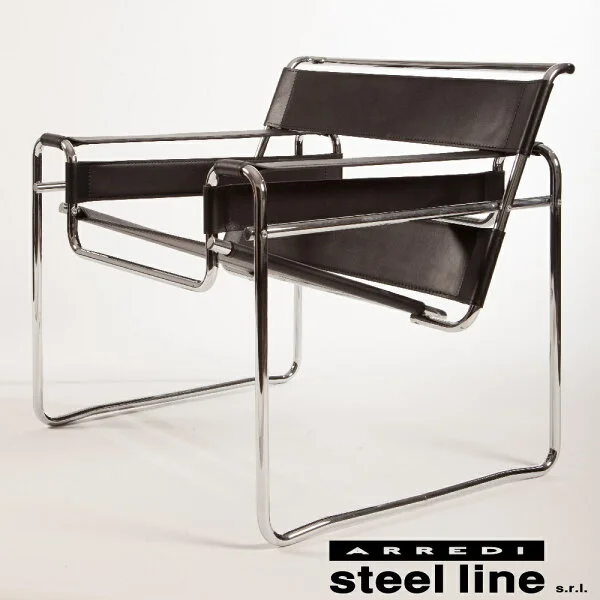
Wassily Chair (B3) Specifications:
- Designer: Marcel Breuer
- Year: 1925
- Style: Bauhaus
- Price: ¥298,000
- Materials: Chrome-plated steel tubing, leather or canvas seat
- Dimensions: 80cm H × 56cm W × 59cm D
Breuer’s revolutionary idea led to the creation of the Wassily Chair, named after his friend and colleague Wassily Kandinsky. This wasn’t just furniture—it was a manifesto made tangible. The chair’s continuous steel frame eliminated the need for back legs, creating a cantilever effect that seemed to defy gravity. The leather sling seat and backrest provided comfort without bulk.
A Design That Shocked the World
When the Wassily Chair debuted, it scandalized traditional furniture makers. How could something so minimal, so industrial, be considered elegant? Yet the chair’s genius lay in its simplicity. The bent steel tubing was not only visually striking but also incredibly strong and flexible, making the chair comfortable despite its austere appearance.
The manufacturing process was equally revolutionary. Unlike traditional furniture that required skilled craftsmen and expensive materials, the Wassily Chair could be mass-produced using industrial techniques. This aligned perfectly with the Bauhaus vision of democratic design.
The Barcelona Chair: Modernism Meets Monumentality
A Chair Fit for Royalty
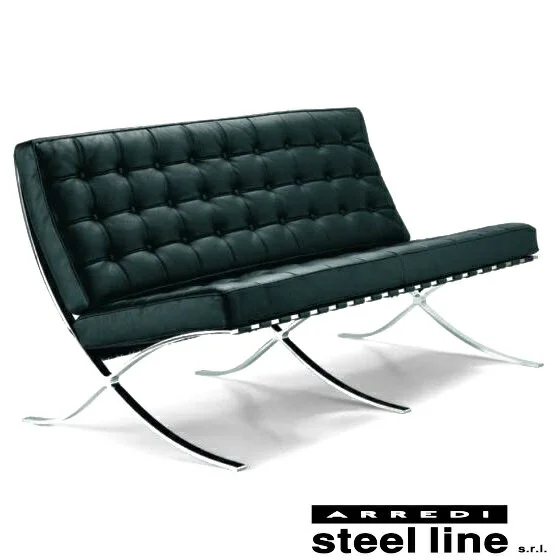
Three years after Breuer’s breakthrough, another Bauhaus master was preparing for the most important commission of his career. Mies van der Rohe had been selected to design the German Pavilion for the 1929 Barcelona International Exposition. The building would showcase Germany’s cultural renaissance to the world, and every detail had to be perfect—including the furniture.
Barcelona Chair Specifications:
- Designer: Mies van der Rohe
- Year: 1929
- Style: Bauhaus
- Price: ¥385,000
- Materials: Polished stainless steel frame, leather upholstery
- Dimensions: 76cm H × 76cm W × 77cm D
Van der Rohe drew inspiration from an unlikely source: the curule seat, an ancient Roman folding chair reserved for magistrates and nobility. But he reimagined this classical form through a modernist lens, creating something entirely new. The Barcelona Chair’s X-shaped steel frame was precision-welded and hand-polished to a mirror finish, while the leather cushions were hand-tufted with individual buttons—a painstaking process that took hours to complete.
The Royal Reception
When the Spanish King Alfonso XIII and Queen Victoria Eugenie visited the German Pavilion, they sat in van der Rohe’s chairs—the first “royal endorsement” of Bauhaus design. The moment was captured in photographs that circulated around the world, establishing the Barcelona Chair as a symbol of sophisticated modernism.
The chair’s success wasn’t just about royal approval, though. Its perfect proportions and luxurious materials proved that modernist furniture could be both functional and sumptuous. The Barcelona Chair became a status symbol, finding its way into corporate boardrooms, luxury homes, and design museums worldwide.
Le Corbusier’s LC2: The Machine for Sitting
The Architect’s Vision
By 1928, the Bauhaus influence had spread beyond Germany’s borders. In Paris, the Swiss-French architect Le Corbusier was developing his own vision of modern living. He famously called houses “machines for living,” and he wanted furniture that embodied the same efficiency and rationality.
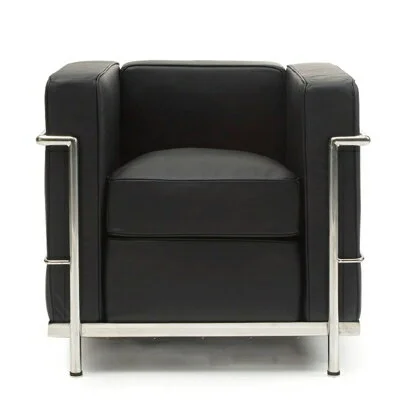
LC2 (Grand Confort) Specifications:
- Designer: Le Corbusier
- Year: 1928
- Style: Bauhaus/Modern
- Price: ¥495,000
- Materials: Chrome-plated steel tube frame, leather cushions
- Dimensions: 67cm H × 76cm W × 70cm D
Le Corbusier’s LC2, part of his “Grand Confort” series, took the cantilever principle in a different direction. Instead of Breuer’s flowing curves or van der Rohe’s classical references, the LC2 was determinedly rectilinear. The chrome-plated steel frame created a geometric cage that held plump leather cushions—a striking contrast between hard and soft, industrial and luxurious.
The Philosophy of Comfort
The LC2’s name, “Grand Confort” (Great Comfort), wasn’t accidental. Le Corbusier believed that true comfort came from proper proportions and quality materials, not ornate decoration. The chair’s dimensions were based on human anthropometry—the scientific study of body measurements—ensuring optimal support and relaxation.
The manufacturing process reflected Le Corbusier’s machine-age philosophy. The steel frame could be mass-produced, while the leather cushions were designed to be easily replaceable—a radical concept in an era when furniture was expected to last generations unchanged.
The Enduring Revolution
Nearly a century later, these three chairs continue to influence contemporary design. Walk into any modern office building, luxury hotel, or design-conscious home, and you’ll likely encounter their DNA in contemporary furniture. The Barcelona Chair still graces executive offices and museum lobbies, while the Wassily Chair remains a favorite of architects and designers who appreciate its perfect balance of form and function.
The LC2’s influence can be seen in countless contemporary lounge chairs that combine steel frames with upholstered cushions. Its modular approach—separate frame and cushions—has become standard in modern furniture design.
The Human Stories Behind the Icons
What makes these chairs truly special isn’t just their innovative design—it’s the human stories they embody. Marcel Breuer’s bicycle inspiration reminds us that great ideas often come from unexpected places. Mies van der Rohe’s meticulous attention to detail in the Barcelona Chair reflects an almost obsessive pursuit of perfection. Le Corbusier’s systematic approach to the LC2 reveals a mind that saw beauty in rationality and function.
These weren’t just furniture designers; they were visionaries who believed that good design could create a better world. Their chairs became symbols of a new way of living—one that valued honesty, efficiency, and democracy over pretension and exclusivity.
A Legacy That Lives On
Today, as we face new challenges around sustainability, accessibility, and social responsibility in design, the Bauhaus principles feel more relevant than ever. The idea that beautiful, functional objects should be available to everyone—not just the wealthy—resonates in an era of growing inequality.
These three chairs remind us that revolutionary design isn’t just about aesthetics; it’s about questioning assumptions, challenging conventions, and imagining better ways of living. They prove that furniture can be more than just functional objects—they can be manifestos, symbols, and dreams made tangible.
Whether you encounter them in a museum or a living room, these Bauhaus masterpieces continue to inspire and provoke. They are physical reminders of a moment when a small group of designers dared to reimagine the world—and succeeded in changing it forever.
Featured Chairs in This Article